 |
| Paul Reever's capture site on Battle Road between Lexington and Concord. Paul was captured here by the British who were trying to make sure word didn't get to Concord that the army was coming to destroy their military arms. |

 |
| Sarah and Aliyah |
 |
On Battle Road near John Parker's Revenge site, Parker led the militia from Lexington to attack the British after their fights at Lexington and Concord. Parker Revenge battle site |

 |
| "The Wayside" Over more than three hundred years, The Wayside and its families witnessed and influenced both Concord's and America's recorded history. In 1775 the Wayside was home to Samuel Whitney the muster master for Concord's minute men and a delegate to the Provincial Congress. In the 19th century famed authors Louisa May Alcott, Nathaniel Hawthorne, and Margaret Sidney (Harriet Lothrop) lived at this incredible site. |
 |
| Orchard House- Louisa May Alcott's family home. Her room was the window right above the front door. Her father made her a curved desk in front of this window for her writings. Orchard House is the former home of author Louisa May Alcott and her family. |
 |
| Today, an amazing 75 percent of the furnishings in Orchard House are the Alcotts', so it remains almost exactly like it was when they lived there. Louisa became one of America's best-loved authors, and it was in this house that she penned Little Women. |


 |
| Concord Sleepy Hollow Cemetery - Authors Ridge |
Authors' Graves
 | |
|---|---|
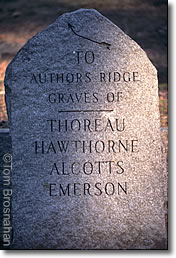
Walk uphill by this |
Walk up the hill as indicated by the stone waymarker. Here are the authors' graves, in the order you pass them:
Thoreau
Henry David Thoreau no doubt knew this ridge well. He knew all the land in Concord from his daily walks as recounted in his journals and books, including Walden.
His simple headstone in the Thoreau family plot is always surrounded by votive offerings left by devoted readers of his works who come from around the world to pay homage to America's first great naturalist. More...
Hawthorne
Novelist and short-story writer Nathaniel Hawthorne was painfully shy in life. He probably receives more visitors in death here on Authors Ridge than he had during his lifetime. His wife, Sophia (Peabody), and daughter Una, moved to England after Nathaniel's death, and were buried there (1870s) in Kensal Green Cemetery, but in June 2006 their remains were brought to Concord and re-interred here in the Hawthorne family plot. More...

Graves of Nathaniel, Sophia & Una Hawthorne...
Alcotts
Little Women author Louisa May Alcott, her father Amos Bronson Alcott, her mother Abigail May Alcott and her sisters are buried in the Alcott plot just past the Thoreau family plot. Her headstone is marked by a veteran's medal and American flag because of her service as a nurse during the Civil War (described in her Hospital Sketches.) More...
Emerson
Emerson gave a speech at thededication of Sleepy Hollow Cemetery (1855), with the thought in mind that he would one day lie here. Now he does, his grave marked by a large, rough boulder of New England marble—a non-religious symbol for a man who started his career as a Christian minister. Next to him are his second wife, Lidian Jackson Emerson, their children, and Emerson's aunt, Mary Moody Emerson. More...
French
You may also want to visit the grave of Daniel Chester French on the ridge you curved along on your way to Authors Ridge. French was the sculptor of The Minuteman, statue at Concord's Old North Bridge; the Seated Lincoln (in the Lincoln Memorial, Washington DC); and the Melvin Memorial, not far from his grave on the other side of the hill. Visitors leave pennies on his tombstone with the reverse side, bearing an image of the Lincoln Memorial, up.
—by Tom Brosnahan


The Minute Man statue by Daniel Chester French
Unveiled for the Centennial celebration of the battle on April 19, 1875, The Minute Man statue, by sculptor Daniel Chester French, is an American icon and has stood guard over this hallowed ground ever since. It is set near the spot where the first colonial militia men were killed in Concord on that fateful day in 1775. The 7 foot tall bronze statue was cast from old Civil War cannons by the Ames Foundry of Chicopee Massachusetts. The pedestal base measures 7 ½ feet tall and 4 ½ feet on each side. Inscribed on the front facing is the first stanza of the poem “The Concord Hymn” by Ralph Waldo Emerson: BY THE RUDE BRIDGE THAT ARCHED THE FLOOD, THEIR FLAG TO APRIL’S BREEZE UNFURLED, HERE ONCE THE EMBATTLED FARMERS STOOD, AND FIRED THE SHOT HEARD ROUND THE WORLD. The Minute Man has come to mean many things to many people. He stands as a reminder that sometimes our freedoms must be fought for, and to never take them for granted. He has adorned the uniforms and flags of our nation’s National Guard as they serve around the globe. This “embattled farmer” has been on postage stamps, U.S. Savings and War Bonds, coins, likenesses of the statue are on corporate logos, as well as used as mascot by local schools. |
 |
| Minute Man Statue with the sunset behind |

 |
The North Bridge in Concord, Massachusetts is often refered to as the location of the "shot heard round the world," and the beginning of the American War for Independence. On the morning of April 19, 1775 , Colonial Militia from Concord and surrounding towns exchanged gunfire with British regulars guarding the critical river crossing. Although the fighting at the North Bridge lasted only a few seconds, it marked the beginning of a massive battle that raged over 16 miles along the Bay Road from Boston to Concord, and included some 1,700 British regulars and over 4,000 Colonial militia. |


No comments:
Post a Comment